Pages

Showing posts with label United States. Show all posts

Thursday, July 10, 2014

Celebrating July

Happy 4th of July to you!

I know—the 4th of July was last week, but it was a busy week, and I’m finishing some thoughts this week that I started a couple weeks ago. This is a slightly belated Independence Day post, but it's mostly about how important this month has become for me.

The 4th of July is a national holiday, commemorating the US's formation, the signing of the Declaration of Independence, freedom, fireworks, and summer barbecues. It’s my own celebration month as well, partly because of the number of family birthdays at this time of year, partly because I started blogging in mid-July.

Yes, I've been blogging for almost three years now. Another week will mark my first post a long, long time ago, back in 2011. That's just over 180 posts ago, with enough words to make a novel, more words than I've managed to write on any of my novels in that time. I’m hoping that part will change soon.

I actually created this blog on the 4th of July, however, while house/dog/cat sitting for a friend. That was the first year I spent the 4th of July away, or any major holiday actually, away from my family, and later that summer, I headed up to Alaska for the first time.

The year after that, while I was in Alaska for the second time, the 4th of July was the day I started a long-distance friendship with a special, extra-awesome guy.

Last year, I was just back from my honeymoon.

This year, as I'm looking back at those past anniversaries, I'm also watching a little munchkin who is already trying to go, see, do, taste everything. We've added a third to our family this year, and he might just inspire some children's stories along the way—something I wasn't ever planning to do.

I’m a fairly quiet person, so I'm not setting off fireworks, but I feel like I should—it’s all worth celebrating. I foresee some busy years ahead, with plenty of changes, surprises, blog posts, and missed deadlines. I’m hoping to make some deadlines as well, finish some projects, and have a lot more quiet celebrations with my family along the way.


What about you? What are you celebrating this month?

Wednesday, September 18, 2013

Last Week


Last week, I almost wrote a post about 9/11. It was something I’d been thinking about in a new way, for a couple reasons. For one thing, when I was tutoring a class of 3rd-4th graders last year, we covered a history timeline from the ancient world up to present day events. I only realized when we reached the line for September 11, 2001, that my students had all been born after the attack took place. For them, and for future generations, that event must seem as old as the Cold War or the Clinton scandals seem to me.

For another, we had a trip planned to DC last week. We happened to fly out on the 11th. Flying on September 11th, to the East Coast, made me consider a number of possibilities, including at very least the potential for extra security at the airport.


Nothing major happened, though. I didn’t really notice anything different from the other times I’ve flown. We had a great trip, walked through a couple hundred museums, saw panda bears and T-Rex fossils. We even had a good—and very long—flight home.

But, when we started our trip back this Monday, with a walk from our hotel back to the train station, we stopped to eat lunch in a park just a couple of blocks from the Capital building. We had talked about walk down earlier to visit the Capital, but decided not to complicate our day. Instead, we had a leisurely morning and time to stop for lunch on the way to the station.

As we sat in the park, we noticed a couple of security agents coming down the steps on one side of the park. Then two others showed up. All of them seemed to be carrying assault rifles, and the group casually converged on a guy sitting at the bottom of the steps. We certainly weren’t used to seeing that, but it didn’t seem to be anything important.

We finished our lunch and strolled across the park and up the steps for a last look at the Capital building. When we came back down, a couple guys from security were still talking to the man, but it still didn’t seem to be anything important—just a casual checkup.

A couple of hours later, after shuttling from the train to the airport, we were waiting in line for security. Standing there, waiting to go through, I heard someone mention a shooting. I got out the iPad (that far too-handy electronic device) and looked up the news, only to find an article about the Navy Yard shooting.

My best guess is that the security agents we saw were just checking things out. The man in the park may have resembled a description they had, or maybe someone had been spooked and reported something, but it gave me the odd feeling of being close to an otherwise foreign event.

And it reminded me of my earlier thoughts about 9/11—how easy it is to forget something, to forget the first emotional reaction to a tragedy. It’s the difference between remembering it, and having it happen to you.

I can’t imagine the trauma and grief for those families affected by the Navy Yard shooting, or 9/11 for that matter, but I know they will remember long after the rest of us catalogue those days with the Maine and the other historical tragedies.
 

Tuesday, August 7, 2012

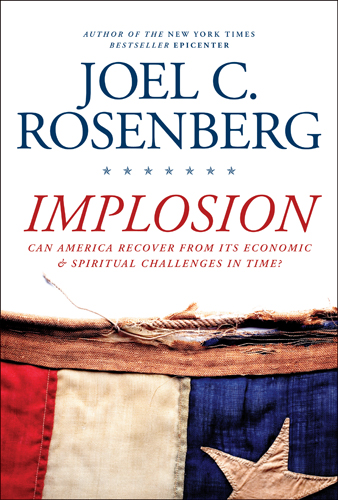
Book Review: Implosion

Recently, I listened as a couple friends tried to pick the one thing which they could present as uniquely American. Perhaps they had experienced some disillusionment, because the only thing they could name was the hamburger…

I don’t agree with them—there are any number of things that we could associate with the American identity, from apple pies to reality TV—but their question returned to me with new significance as I was reading Joel Rosenberg’s Implosion, a nonfiction look at the United States’s current state of health. What does the US have to offer the world? Or, rather, what is left of our greatness that we can protect, revive, and restore to a world in chaos and fear?

Rosenberg, an author, political expert and homeschooling dad, writes that he has built his career in the two things other people don’t talk about—religion and politics. He deals with both in Implosion, taking a broad look at America’s political, economic, and religious health. While I have not read much of Rosenberg’s fiction, I am familiar with it, and he deals with many of the same themes in this book.


In Implosion, Rosenberg doesn’t offer immediate reforms, or sure-fire cures, but he does highlight major problems in American society, and the disturbing reality of where we're at.

In the first couple of chapters, Rosenberg gives a sweeping overview of the doomsday predictions from political leaders and pollsters. I found these chapters difficult to read, but once past them, Rosenberg addresses a wide array of issues, from the role of Scripture in looking at current events to the accuracy of prophetic revelation to major dangers the US faces today. He looks at the possibility of a crippling terrorist attack, an economic meltdown, a devastating earthquake, and even the likely impact that the Rapture could have on today’s society and economy.

I disagreed with Rosenberg on a couple issues, the first being that America is in a uniquely catastrophic state. We are in bad condition, yes—but much of his evidence relies on pundits’ hyperbole. He speaks of recent natural disasters as the ‘worst’ earthquake ever, the ‘most dangerous’ point in our history. I can’t cite chapter and verse like Rosenberg, but I know that many other eras saw their own time as “End Times.” From the American Revolution, the Civil War, WWII, and every era in between, people have proclaimed that theirs is the highest, or the worst, the most advanced, or the most degenerate of societies. It’s the way we think as humans because we so often lack historical perspective.

In the chapters describing the US’s immanent collapse, therefore, I tended to discount some of Rosenberg’s predictions. This did not affect, however, the urgency of his message that we need to shape up, and we need to shape up now.

Moreover, for me, this urgency raised another question—if this is how things are now, where will we be raising our children? Rosenberg doesn’t address this question in Implosion, apparently because he doesn’t think it will be relevant if we can’t turn our country around at once.

Even when he lays out a devastating case for change, though, Rosenberg doesn’t point to political cures. Instead, he argues for a religious reawakening. The last third of the book reviews America’s original Great Awakenings, analyzing those turning points in our history and describing the influence of several key religious leaders. These include leaders many people know—Charles and John Wesley, Jonathan Edwards, George Whitefield—and ones we aren’t so familiar with like Lyman Beecher, Francis Asbury, Charles Finny, Timothy Dwight (a president at Yale, as well as a major leader in the Second Great Awakening).

My second, relatively minor disagreement with Rosenberg stems from his arguments for a pre-wrath Rapture. I don’t necessarily think Rosenberg is wrong on this point, but I don’t agree with some of his definitions on this position. (Rosenberg thinks the ‘wrath’ which Christians do not need to fear means the Tribulation, while I think it means the final judgment; he takes the churches in the first chapters of Revelation as figurative types, while I think they were actual 1st century churches, though they could serve as types as well.)

Rosenberg does make good points, however, and defines his position well. He particularly hammers the urgency of evangelism—that we don’t know the day or the hour, and so we should take advantage of the time that we have, always working as if it is our last opportunity. He demonstrates his own passion for evangelism both by describing what it means to be a Christian and by outlining key steps for Christians to take for their own growth.

This last point forms a strong theme throughout Implosion. Rosenberg argues repeatedly that we should be passionate about the Gospel. And, he asks—what you are passionate about, what you love, do you spend time on that?

In the end, I found Implosion to be a well-written engaging survey of America’s current state. Rosenberg covers some areas more in depth than he does others, and it is easy to see his passion for finding the right lens for understanding current events. If you don’t read much nonfiction, or if you aren’t interested in the topics Rosenberg addresses, this might not be the book for you—but it might be a good read anyway.

[My thanks to Tyndale Publishing House for sending me a review copy of Implosion, in exchange for my honest opinion of this book.]