Pages

Showing posts with label problems. Show all posts

Wednesday, July 2, 2014

Squirrel Attack


I've been concerned about my lettuce plants for a while. First there was the lack of sun. Then there was the heat. Now it's the squirrels.

Yes, the squirrels. They’re back—or still here.

The squirrels were a lot quieter during the winter, but I notice them fairly frequently these days. It's great fun to watch them jump between the trees. I haven't seen any fall out of a tree this year, not yet. But sometimes when I see one girding up for the leap, I'll grab my camera and start recording…just in case.


Just last week, I glanced out the window and found a squirrel staring at me from the porch rail. 


He wasn't terribly interested in me, though. After a moment, he jumped down onto the porch and started rummaging through the pine needles. He had a peanut in his mouth—probably stole it from the neighbors upstairs—and he seemed to be trying to find a place to bury it.

Poor squirrel—we only had carpeting under our pine needles, nothing deep enough to hide a peanut. Still, that’s when I decided it might be time to sweep the pine needles off the porch.


The next day, a different squirrel showed up. How do I know? He was distinctly redder than the first one, as well as smaller. I’m just not sure whether the same squirrel showed up twice that day, or if I managed to spot Squirrels Two and Three relatively close together.

The squirrel (or squirrels) also seemed to be hunting about in the needles for a place to hide something.

A couple days ago, I did manage to sweep the porch, and the result looked so nice that I sat out there a couple times in the past week. Warm afternoons and a clean porch are great at encouraging me to go outside.

Unfortunately, when I went out on the porch today, I found one of my lettuce pots had been knocked over. A couple others had the dirt shoved around. It seems the squirrels are persistent, though maybe they decided to eat some greens with their peanuts this time.

Oh, well.

Actually, I had already spotted signs that my lettuce sprouts were trying to sprout flowers, instead of growing up into big lettuce. At least I still have green stuff other than moss growing on my porch. That's all that really matters.

That, and healthy squirrels who know when to eat their veggies.

Friday, June 20, 2014

Why the World Needs a Better Butter Tray


Around this time last year, when the two of us set up house together, we bought a butter dish.

What’s important about a butter dish?

Actually, the butter dish are very important, along with salt-and-pepper shakers and candle holders. The butter dish may be the one thing we use every day, apart from the fridge and the oven, of
course.

When I was growing up, butter was important for my family. We used it in the morning to fry our eggs. We used it in the evening to butter muffins.

My family had a couple different butter trays, but the main one was a beige plastic tub. It had a flat tray with a semi-rough texture for us to set the stick of butter on, and it had a flat-topped cover that snapped over the tray.

Why am I even thinking about this?

Last year, I married a UX designer. UX designer means user-experience designer, or someone who tries to make sure people can use the product the way it’s meant to be used—without tearing their hair out in agony. The term applies mainly to programs IT people use, but someone out there is responsible for designing butter dishes.

Over the years, my family dumped the butter on the floor several times—both with and without the cover on. Sometimes the cover kept the butter from making a mess. We washed the greasy butter off the tray countless times. We tried not to get it messy, but the lid usually stuck a bit. Most of the time, as we pried the lid off, one corner would bump into the butter. It the butter was soft, the lid got especially greasy, and we’d have to wash it even more frequently, soaping away the butter and crumbs, before unwrapping a fresh stick of butter and setting it carefully in the center of the tray.

So last year, my husband and I made a special point of getting a butter tray. We even picked out a glass one. We picked out one without a snap-on lid, thinking it would be a nice tray for every day and special use, easy to use, easy to clean, and easy to keep clean.

We were wrong.

The lid doesn’t snap on, but it doesn’t have a handle either. We can’t lift it straight up and down, so to use it, we have to slide the lid until we get a solid grip and lift it off.

The bigger problem, though, is the tray’s size. With something designed specifically for butter, you might expect the tray’s designer or manufacturer to find a stick of butter and measure it to make sure it actually fit into the tray’s proto-type.

One brand of butter does fit okay, because it’s a longer, thinner stick of butter. Most butter, though, comes in short, stubby sticks. The lid on our butter tray is about a millimeter too short for those brands of butter.

I refuse to buy a different brand of butter just to get a stick of butter that fits into the butter tray. I’m also not going to shave the top millimeter off every stick of butter I put into the tray. So, our butter tray will inevitably have a thin streak of butter across the top of the lid.

Someone out there failed, and because I married a UX designer, I now notice things like that.

I also notice little things about websites, like the site that has its log-in box only on the front page, in a small sidebar of the front page, and the other sites where you can’t log out—you can only click the little tab meant for “if you’re not the person who’s claiming to be logged in.”

Good design is important, and the world will build a path to the door of the designer who builds a better butter tray.

I guess you can say it's been a good year, though, if that's all I can find to complain about.

(Also, it’s true that you should choose your friends wisely…because the people you hang out with will affect you, sooner or later.)

Thursday, January 23, 2014

There’s a Mouse Under My Sink

First it was squirrels falling out of the trees. (Maybe they were confused and thought it was the Summer Olympics coming up?)

Now it’s a mouse under the kitchen sink.

How do I know? One recent evening, as we were sitting on the couch in our living room, we noticed a rustling noise in the kitchen. It sounded odd, but it stopped after a moment.

Then it started again.

The first reconnaissance trip found nothing. All was calm, all was peaceful, all was quiet—until a couple minutes after we sat down again.

On the second reconnaissance, I waited at the kitchen doorway until I could hear exactly where the noise was coming from. It wasn’t in the pantry. It wasn’t behind the refrigerator. It was under the sink.

I moved a little closer and waited again. When the rustling returned, I opened the cupboard just in time to see a garbage bag stir as ‘something’ jumped out and disappeared.

No—I didn’t actually see the mouse. Circumstantial evidence, however, led us to conclude that the rustling noise was in fact a mouse.

Fortunately, Señor Ratón hadn’t traveled as far as the pantry yet. I’d been planning to find storage boxes for the pantry—eventually—but this was an emergency. The Christmas candy went in our spare water-bottles, while the rice and pasta moved into a big six-quart kettle. I jumbled the rest the spare glass jars I’d been saving for ‘something’. We emptied under the sink as well, moving the garbage can out and setting everything else on the counter.

Of course, that made more clutter in the kitchen. A couple days later, therefore, I decided to compromise. I put the dishwasher soap and a few other miscellanies back under the sink and left the garbage can out. I figured the miscellanies would be safe as long as I kept any and all food out of the way of Señor Ratón.

About twenty minutes later, as I was reading in the living room, I heard a series of small thumps. Mr. Mouse had found the spare scrubber, apparently, and seemed to be using it for his bowling practice.

After that, the soap, scrubber, garbage bags and all went back on the counter.

We haven’t heard anything since. My guess is that the mouse can get under the sink by squeezing past the pipes. Everything else is sealed, so he shouldn’t go any farther unless we happened to leave the cupboard doors open. That’s just as well, because I’ll feel friendly toward him only until he gets into something important.

Though perhaps the mouse was as confused as the squirrel gymnasts—he might just have wanted to practice his shot putting.


At any rate, there’s a mouse under my sink.

Wednesday, December 18, 2013

Do Dragons Monologue?


I started last week by watching The Fellowship of the Ring and The Two Towers. I ended the week by watching The Desolation of Smaug. As you might guess, I have Tolkien on the brain, and some observations about the movie. If you’ve watched it, I hope you find them amusing. If not, well—I’m trying to avoid spoilers.

#####

First, how can a movie change absolutely everything about a story and still be the story?

Second, is it okay to laugh through an entire fight scene?

Is it more or less okay when the orcs are losing their heads right and left? I’ll admit that I was slightly worried about seeing Legolas again. It seemed such a perfect chance to ruin things, but somehow he tops even skateboarding on a shield. And, I’ll never underestimate Bombur with a barrel again.

To go back to the orcs, however—as was shown in the Lord of the Rings, some orcs simply cannot be killed, no matter what. In my opinion, Dark Lords would be better served by spawning those orcs in fewer quantities than by spawning prodigious hordes of red-shirt orcs. I could be mistaken, though, since it might just be the difference in technique when one is fighting a single orc rather than a whole gang of them.

What about ADHD dragons who can’t decide which dwarves to chase first? Sure, Smaug showed a lot of inconsistencies, but he did have a lot going on after years of boredom. And, he obviously has trouble making up his mind. It’s no surprise, then, that he has unfinished business to distract him at crucial moments.

On the other side of things, with apparently too much time on his hands, we have Thranduil. All I’m going to say on that score is—if Thranduil and the rest of the elf army should flake out again and end up MIA for the battle of five armies, everything will still be okay. Legolas and Tauriel can be an army by themselves.

Speaking of Tauriel, I’m not going to complain about that particular change. It hardly seems important after some of the other changes. I understand some people just want to see more strong female characters, and others can’t stand a story without a romance plot of some kind. To be strictly honest, though, adding Tauriel hardly passes the Bechdel test, while as for the romance story…

No, I’m more upset about that whole morgul arrow thing, because…what am I supposed to think? That Aragorn learned his herb-lore from ‘watching’ this version of the quest? I can just picture the scene, when Gandalf and Bilbo finally make it back to Rivendell:

#####

(As Bilbo finishes the story, probably related to him by Oin or Bofur…)

Elrond: “What? The dwarves knew about athelas?”

Gandalf: “It’s true, Elrond. I hardly believed it myself, though lucky for them that one at least had some sense to find the plant before it was too late.”

Elrond: “But how did they learn of it? Dwarves do not usually care to study such matters. Aragorn, go ask Arwen if she told one of the dwarves about athelas.”

Aragorn: “She didn’t, uncle Elrond—I did. At least, he heard about the library and wanted me to show him, and he saw your scrolls on healing craft. He told me all about the mines of Khazad-dum, too. Is it true that the dwarves woke something in the deep places, with their digging?”

#####

I mean, if Peter Jackson can do it, I can too. (The only thing I’m holding against him right now is how he makes the story just slightly less magical—I insist upon having a talking thrush or raven or something.)

Finally, as for whether or not dragons monologue—of course they do! It must be lonely living alone in a cave for hundreds of years with a mound of treasure. Besides, dragons are the sort of creature that would love the sound of their own voices. Such a rich, golden sound it is, too…

Friday, November 15, 2013

Words == Power?

A couple weeks ago, I learned how to draw a line.
 
To be more specific, I'm taking an online programming class. In addition to NaNoWriMo. And a couple weeks ago, I learned how to write a line of programming code that displayed a line on an otherwise. That was fun.
 
This week’s project? Well, the class has gotten a little more complicated over the past couple of weeks. Instead of typing out simple lines like canvas.draw_circle(…), we’re getting to create trees of if/elif statements and “for loops.”
 
Sounds like fun, right?
 
The problem is, programming means getting the right words into the right place. Most writers can get by without being very specific. We can talk about “a dog,” if we want, and not bother about German Shepherds unless we’re dog-fans. But in programming, if it’s a German Shepherd, you have to say it’s a German Shepherd. Otherwise, you get a blank stare. If it’s a circle you want, you have to say “circle,” not “a round-shaped” object. No "round shaped" tires here, please!
 

Then there’s the matter of getting the words in the right place.
 
I spent about twice as long as I should have on this week’s project (creating the card game Memory, complete with code to “turn” cards over and match the pairs of cards as a player finds them). One of my problems was making sure that all of the code had the proper indentation. 
 
 
You see, when a program runs, it runs straight down the code. But, if there is an “if” clause, the program has to detour and check out all the code under the “if”, before it can go back to the rest of the program. And the way it knows whether something is part of the “if” clause is based on how much the code is indented. Once the indentation ends, the program assumes things can go on as they were before. (And you thought indenting only mattered in English 101.)
 
Then there was that problem with trying to talk about that German Shepherd before the program knew what a German Shepherd was. My challenge was that the line of code I needed would send everything into a downward "for loop" if I wasn't careful, but I thought was inescapable, since I could only talk about my German Shepherd once I introduced him to the program—in the "for loop".
 
Eventually, with some help, I found that I didn’t have to talk about the German Shepherd at all in that case—I could talk about a Poodle instead, since the Poodle had the same value as the German Shepherd, at least as far as telling the program what I meant. Makes sense, right? 
 
That’s about as intuitive as using a cookbook to find books in the library instead of the library catalogue.

And then, I can make things fancy, by inserting images:


Now, when I see flashing electronic signs or cash registers, I can’t help thinking about all the if/elifs and "for loops" that went into making that piece of machinery function correctly.
 
And yes, words are very powerful. If I create a line on a blank canvas, and then change one small word, I can change the color of the line from “Red” to “White.” Pictures, on computers at least, really are made up of a thousand words (more or less). Change one, change the picture.
 
Just think what words can change in a story or a conversation.
 

Tuesday, October 8, 2013

Historicity: Back to the Big Picture


Last week, I complained about the problem of details in writing—especially writing that involves researching obscure historical details.

Research is even important in make-believe worlds, because farming methods, by whatever name, must still make sense to readers, along with weapons, battles, climates, houses, cloth manufacturing, and cognitive development patterns.

Details are important, as any writer could tell you.

Of course, the big picture is just as important. I’m not talking about plot. Yes, it is challenging to create the goals and conflicts and overarching structure of a novel, but the plot itself needs to fit into the structure of its world.

I found this out after deciding to revisit a colonial-era novel I once wrote. It was my first novel, which I finished almost five years ago. Since then, it’s waited patiently for me to get through college, finish up my research, and start on the editing.

You could call it a learning experience.

I knew that the book needed a lot more research. For example, I had found some obscure details about the fact that New England Puritans believed in an orderly society, and that they founded towns as units, not necessarily as pioneers straggling out into the wilderness to find a homestead. For a Puritan family to pick up their household and head out alone (as the Ingalls did later on) would seem scandalous.

No one I’ve found explains much about how these town-units actually formed, but I wanted to include that detail. I figured that with a couple other details about how the settlers would pick a town site, clear the land, and build their houses, I’d be well on my way.

Things looked so promising that I picked a corner of the map for my (fictional) settlement and looked up information on some of the towns formed around there. I even found a couple towns settled close to the time I had picked. This, though, only happened after I wrote the rough draft and was ready to look at some revisions.

Then I started looking into some other details. I found out that the towns I wanted to use as models were actually splinter-groups breaking off from larger settlements that had been founded at least 50 years earlier. In other words, all of the main settling and civilizing had happened much earlier than when my novel was set.

I could fix those sorts of details with a bit of tweaking, but next I realized that my chosen region lay very close to the Mohican trail, and that this what about the time of the French and Indian War. In fact, one of the small settlements I had found was created as a barrier settlement with a fort, to defend more developed areas from Indian raids. And, this was after some of the major threats had tapered off.

Now I had the wrong area, or at least the wrong time, and the wrong story entirely. And, apparently, my original story either needs to change, or adapt to its frontier conditions.

Or, it might just get buried as a first-attempt novel no one needs to publish. Remember that learning experience I mentioned earlier?
 

Tuesday, October 1, 2013

Historicity: It's in the Details

I’m on the history-wagon at the moment. It might have something to do with my attempts at novel-related research.

Actually, it probably has a lot to do with that.

That’s because I’ve been doing a lot of research recently. Part of my research is supposed to be developing a medieval setting for my fantasy series. That’s an issue on its own, and it has only proven so far that I need a better mix of primary source documents and re-enactors guidelines—like that one Daily Life book targeted specifically at the Society for Creative Anachronism.

Most history books, you see, assume that people want to know about important things. Things like which king fought that other king, until he decided to marry the other king’s daughter instead—and then kept fighting anyway.

I like that sort of history. I really do. I can even remember a few dates, enough to know when the Magna Carta was signed (June 15th, 1215—it’s easy to remember with two fifteens in the date). Still, I do prefer to read about people’s stories within history.

There was one lady, for example, famous for helping to hold off Viking invasions. She showed up in my research for a Medieval Literature class, and I liked her. I’d like to write a story about her, or someone like her, if I can ever dig out my notes to remember who she was.

It’s just that, if I want to write about her, I also want to know what sort of architecture was used in the town she was defending, how the townsfolk planted their fields, what they planted, whether they got to eat most of it or whether it was destroyed by the fighting or went to pay taxes, or was traded off for salt or leather or iron. Did most people wear shoes? Did they go to church? What sort of liturgy would the priest use?

And, even though I’m not writing about medieval England at the moment, I want to know things like this for my fantasy series. I’m supposed to be creating a semi-medieval setting, if I don’t take it forward to renaissance in some places.

Of course, since I like old, old history in general, this research might become an excuse to write other types of fiction (see the famous lady example above). It’ll just have to wait until I have time, and until I can put it into much better and much more thorough order. And until I get better at finding the right sort of history books.

That might be the real problem. I fail at being a historian. History research takes organization, both in putting information into order, keeping track of it once it’s in order, and in starting the research off correctly. Just ask me about my New England novel…

Or maybe I’ll just tell you about it next time.

Wednesday, September 25, 2013

Back on Murder: Review

 
Last week, I posted about 9/11 and how people remember tragedies. Oddly enough, just after writing that post, I read a book that dealt with similar topics.

#####

Back on Murder is the first in a series by Christian writer J. Mark Bertrand. I mentioned the novel back in August, when I’d only read the first chapter. Now, after finishing it, I have to say that the book was a lot of fun.
 
It’s not a pretty story—once a celebrity thanks to a high-profile case, homicide detective Roland March has lost a lot of trust, and he’s been forced onto the sideshows. He’s desperate when he happens on an obscure clue in a drug-house murder scene. March hopes that the clue might be his big chance for a comeback, and he’s willing to bend the rules since this appears to be his last chance.
 
#1: Back on Murder   -     
        By: J. Mark Bertrand
 
Then March’s murder case is eclipsed by the latest breaking news—a missing girl, whom March pegs as white, popular, and everyone’s perfect daughter, sure to keep the media attention as long as there is a scrap of news left to be wrung out.

March has a hunch, for his own reasons, that the cases might be linked, but no one else believes his theory. And, in the background, March has to deal with his own failings, his wife’s depression, a painful past, the coming 9/11 anniversary, and the way the newest ‘breaking news’ obscures both national tragedies and personal grief. He’s in big trouble before he realizes just how careless he’s been.

All these elements make for a very real world scenario, and one that reads very vividly. While Betrand is a Christian novelist, and a number of church characters show up in Back on Murder, March is agnostic, when he’s not bitter against the world in general. Even the good characters make mistakes and have to start over, while March’s investigation turns up a lot of corruption and desperation in others’ lives as well as in his own.

More important, Back on Murder has a catching plot, and even better writing. Aside from the fairly graphic descriptions of violence, I think this is a book anyone could read. It’s a book I enjoyed enough that I’m planning to look up the sequels.
 
(Note: Back on Murder is free on Amazon for Kindle readers, which is how I picked up my copy. For other readers, there's also a preview for the first chapter.)

Monday, June 24, 2013

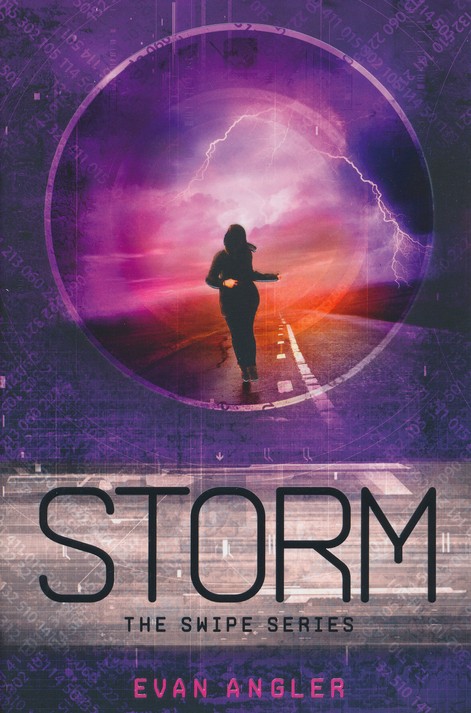
Storm: Book Review


Evan Angler has annoyed me.

Storm, Swipe Series #3About two months ago, I sped through his first two books, Swipe and Sneak. The ending of the second left me hanging, waiting in suspense for the third book—and the end of the story, I though.

Now, finishing Storm, I’ve found there is still more to come, and the suspense is as high as ever.

In the first two books of the Swipe series, Logan discovered the secrets behind the Mark process, and then behind the government’s secret prison. Along the way—and on the run from DOME agents—he learns some other things aren’t as he expects them.

Now, after those breath-taking, and gut-churning, discoveries, Logan learns another secret. The virus meant to control the Unmarked has started to attack people. And, it’s the Marked that are getting sick, including Logan’s friend Erin. There’s no known cure, but there maybe someone who can help, far out in no-man’s land.

There’s another minor problem—a problem in the country’s midlands, where crops are dying from the drought. After the disruptions of a global war, natural rain is almost unheard of. So, the government has to manufacture rain—and the scheduled cloud-seeding is far behind schedule.

Like the first two books, I enjoyed Storm for its action. Some of the characters seem a little flat still, but reasonable for a YA novel. The speed of the plot also doesn’t leave much time for lingering on any character or incident, but Angler creates a very convincing dystopian world. He spends some time on both the suppression of religion in this peace-seeking American Union, as well as its gradually rediscovery and spread—connected to a few faithful and the new underground movement.

Other highlights—in the previous books, I appreciated how Angler explains the development of the new world order. This time around, I enjoyed his version of a West-Coast tech industry as far out in many ways as Silicon Valley is today. And, Angler himself makes his own cameo appearance this time around.

You might not have to read the first two books to understand the plot for Storm, since Angler does a fair job of retouching his characters here, as well as moving the action along at a fast pace. At the same time, you probably would miss out on some of the story. Besides, for YA dystopian novels, they’re worth the read. I’d say the same of this one.

#####

This week, Monday through Wednesday, is the Christian Science Fiction & Fantasy blog tour for Evan Angler's new book Storm. This review was also posted today at Myrdan.com, as part of the blog tour. Feel free to check the site out for more on the book, including a list of other tour participants.
 

Thursday, June 20, 2013

Deadpan Fiction & Dragons


Recently, I was thinking about how deadpan humor might be like fiction writing. As always, thinking is dangerous…

(I also have dragons too much on the brain.)

So, how would deadpan humor like fiction? According to most definitions, deadpan humor comes when someone relates something rather funny, or outrageously impossible, in a matter-of-fact, serious manner.

Perhaps you could contrast deadpan writers with those who do include a wink-wink signal in their story—something in tone that says…

“And wow—that’s when the dragon showed up! (Yes, I know there aren’t any such thing as dragons, but really I was just as surprised as you. Humor me, because I’m trying to tell a story.)”

Done right, it can be quite good indeed, though it’s not the style I usually use.

In fact, when I write, or tell a joke for that matter, I like to be serious about it. I might even be too serious—given the rough draft of a novel I’ve been rereading. I can also be a bit random, which is why I wrote this instead of actually working on my novel…
 
#####
 
“Last Tuesday was a bad day for me. I spent the morning trying to clean out the garage—everything I’d thrown in there since last winter—and that took me almost until noon. Then, once it started to look like a reasonable place again, I remembered that shopping run.
 
I checked my watch—11:38. Just time to pick up a few groceries and be back for lunch.
 
I was driving down the long hill when something flashed by me. I felt a lurch, and a crash, and my car spun once. As I smashed the brakes, it skidded and flew like a brick into the ditch. It settled slightly, before nosing against a tree with a dark crunch.

I sat frozen, clutching the steering wheel.
 
In my peripheral vision, I saw the blue car disappearing around the bend, followed by another flash. Black-and-white—a police car. A second, third, fourth followed. Then another and another, sirens muted, but lights flashing crazily.
 
Then everything was still. I stared straight ahead, noticing how one of the tree branches mirrored the crack in my windshield.
 
“Great,” I said. “Just great.”
 
Slowly, the smell of hot oil roused me. I shook myself, looked around, and tried my door handle. It opened, and I stepped out.
 
As I stood staring at the car, a police car pulled up behind me. The officer got out, leaving his door ajar and hurrying toward me.
 
“Everyone okay?” he asked. “Were you the only one in the car?”
 
“Yes,” I said.
 
“Are you okay?” he repeated.
 
I shook myself and looked away from the car, meeting his eyes almost accidentally. “I’m fine. I just don’t know…” I looked back at my car, listing against the tree.
 
“It’s okay. I’ll call a tow truck. Do you remember what happened?”
 
I told him I was just driving to the store, when out of nowhere…
 
He had his notebook out, jotting in it quickly, but he raised one eyebrow. Somehow the gesture made me feel simultaneously that he wasn’t surprised by my story, and that he didn’t really believe it. I wondered if he'd been trained for that expression.
 
“There were I don’t know how many police cars. I’m glad you stopped,” I added.
 
“Yeah—let me call that tow truck,” he said.
 
He was back a couple minutes later, with another series of questions, and a form for me to fill out. The form had questions about my insurance company’s information, my personal information, my car’s personal information…
 
“You’ll need to fill that out and mail it in,” he said. “I’ll just ask you a couple questions right now.”
 
About twenty minutes later, he was still asking questions when I heard the truck engine grinding up the hill. We both looked up and watched as the tow truck lumbered around the bend and swung off onto the opposite shoulder.
 
The driver got out and waved to us, before heading around to the back of the truck. In another moment, he reappeared and headed across the road.
 
That’s when the dragon showed up.
 
#####
 
[In the next chapter, which doesn’t exist, the tow truck driver explains that while dragons prefer coal, they can’t find any in this region, so they prefer motor oil…
 
“You should have seen our garage the last time one showed up—it was an inferno.”
 
“Oh,” I managed to say, as we peered over the logs. I cringed as a heavy crunch sounded through the overhanging branches. I know my car as already wrecked, but still…
 
“This one probably smelled the leakage from your car,” the driver added helpfully...]


Friday, June 14, 2013

Shortcake Experiments


In addition to writing more recently, I’ve also had the chance to try some different types of cooking projects.

It’s been interesting.

For instance, earlier this week, I needed to whip some cream. Always before, I’ve whipped large amounts of cream, using that ever-so-handy tool called an electric hand-mixer.

This time, since I was only trying to do a small amount—say enough for two people—and I didn’t have that mixer ready to hand, I tried using a whisk. The super-miniature cup-of-hot-chocolate-sized whisk, to be precise.

As with all experiments, I had my purpose, hypothesis, materials, and procedure. I wanted to make whipped cream, I guessed that using a whisk would help me reach that goal, I had the cream and whisk ready, and now I just had to whisk the cream. It should have been enough, right?

Probably it would have been enough—if I had been patient enough.

I whisked for several minutes. Someone else whisked for several minutes. I tried whisking again for several more minutes. The cream seemed thicker, maybe a little bubbly, but it still ran like cream when we tilted the bowl. Results: no whipped topping in sight.

That’s when we got the idea or new hypothesis—I did actually; I’ll take the blame—to put the cream in a tub, put the lid on, and shake it.

New results: We got butter!

But still no whipped topping in sight, in the tub, or anywhere else I could find.

So, we stored the butter away for later—and dumped a new batch of cream into that ever-so-handy blender!

This time, after several minutes of beating in the blender, the cream seemed a little thicker, maybe a little bubbly, but still way to runny to count as whipped topping. Same again...

Final results: we just used semi-liquid cream.

And my experiment report?


Conclusion: it’s always helpful to have the right tools for a project.

Alternate conclusion: Strawberry shortcakes still taste good, even if my hypothesis was wrong in all three cases. (But please don’t tell my sister how I cook.)

Friday, June 7, 2013

Impossible Things


When I started on this blog almost two years ago, I had big goals for posting regularly, posting about my writing projects, and above all writing out thoughtful posts.

I stopped posting for a while this winter because I ran out of thoughts. There I was as blank-eyed, and as lacking in inspiration as a...


Never mind.

Still, you may have noticed that last month’s posts consisted of photos and book reviews. I should probably note here that I wrote all except the last of those posts at the end of April, and scheduled them out through May.

Why? Because I’ve been busy. Preoccupied, you might say.

Now I’m back—sort of—and I’m trying to write again.

Not just an occasional book review, but something solid, something productive, something to do with a novel.

I have half a dozen novels in my brain right now, but I’d settle for just one.

Writing, however, seems to mean dealing with lots of impossible things. I could list scores of examples, but I’ll just mention the problem of sitting down to get something done on a regular schedule. It sounds impossible right?

It is a bit of a challenge, I must confess, especially after neglecting my writing for about six months.

I’ve written bits and pieces along the way, but I’ve been distracted. (A very good distraction, yes, but that’s neither here nor there—I refuse to be distracted from my topic right now.) At any rate, it seems almost impossible to clean out the dust and rubble of half-forgotten stories.

Fortunately, I'm also learning a lot about impossible things, and it seems they do happen. What things, you ask?

How about a dogfish, that is a catfish? Or rather, a catshark?

Or, what puts a fireman into the same category as a computer programmer? Apparently, both are creator/craftsmen personality types.

What if Mordor is across the river from the Philadelphia zoo? Though I wonder what the lions think about that. (And please, please—let me know if you happen to visit there and catch a glimpse through the Morannon.)

And, a video clip a friend sent me shows that it's possible to make an orchestra out of landfill rubbage:


So, who am I to say it’s impossible to write a simple thing like a novel?

(I'll get back to you on that one.)
 

Friday, January 11, 2013

Would you go to the moon?


No one has asked me recently if I want to go to the moon.

At least, if anyone has tried to email me or send me notices of a free space flight, a once-in-a-lifetime offer of a trip to the lunar satellite—well, the notices haven’t yet shown up in my inbox or my mailbox.

But I have wondered recently—if someone offered me a trip to the moon, what would I say?

Some people could probably tell you what I would say…it depends…

But what does it depend on? How many months or years of preparation it would take? How nervous the idea of space travel makes me? How well the safety statistics are balanced toward survival? How much I might or might not have dreamed of walking on lunar dust?

Or does it just depend on whether I can say yes or if I’m more comfortable hiding behind the answer no?

How often do we miss adventure just because we decide it’s not for us—that space beyond our tiny layer of atmosphere is just too far beyond our comfort zone?

In other words, if someone offered you a free trip to the moon, would you take it?

Thursday, September 6, 2012

Rescuing Books...

...rescued by books?

Very early this summer, not long after I arrived at the lodge, we were told that some old books were being moved from storage into the burn pile. Oh, and there were some books in with all the rest of collection.

Let books be burned? Certainly not!

 So, another girl and I trekked down to the burn pile and picked through it, rescuing as many books as we could. (Though not all of them, sadly—I'll do better next time, I'm sorry, mea cupla...)


I came back with an armload of books—a few well-known classics, and a few oddballs, like Just So Stories and The Call of Alaska.

This was in May.

It's now September.

I've read the first couple chapters from two of these books; I've even read one of them clear through, along with a few others books I'd brought from home. Most of the books just sat on my shelf, though, and waited.

And waited.

And waited.

Then one of the girls asked me this week..."Are you alright?"

I was surprised. Yes, sure, I'm fine. Tired, but that's normal around here. Maybe a little disconnected, maybe a little crazier than usual, but still fine, just fine...

A couple hours later, though, I realized there was a major problem in my life. One almost unbelievable and most certainly inexcusable.

I hadn't read a book in over a month, not since I posted my last book review.

Now, I may have read a short section from one of my rescue books, and I might have looked at a couple photo books. In all that time, however—in an entire month—I hadn't sat down and read a book.

Among English Majors, that must be a record. I know it is for me, and fortunately, I knew at once how to remedy it. That afternoon, I pulled out one of my thickest books, climbed onto the top bunk, and started reading. (It was not, I must admit, one of the books I'd rescued, but one of those I'd brought with me. It was a book, nonetheless.)

I didn't get far—time tends to get a little limited around here, with only two hours off between cleaning cabins and prepping for dinner. But I did get some mental relief, and a brief trip to another place, before I came back to lodge life and headed upstairs to chop cucumbers for that night's salad. I'm planning to head back to the book again soon.

So, how's it going here?

Still sane!

Hurrah for books!

(Beautiful, beautiful books!)

Oh, and some other news for this week...


...the snow this year was almost exactly two weeks earlier than it was last year.

Thursday, August 30, 2012

Not the Top

How do you say “I hiked the mountain,” when you didn’t actually hike the mountain?

At least—if you hiked up the mountain, but you didn’t quite reach the peak?

If, in fact, about ten minutes away from the peak, you decided to turn around and go back?

I promised this post about three weeks ago, soon after making the hike, and I nearly told it last week, until I was distracted by the story of another hike. So, here it is at last, the story of my journey up the mountain.


All journeys start with a path, and ours was no different—from the lodge, I set out with four other mountain climbers, all of us geared for steep crags, blinding snow, blizzards, and dehydrating heat.

Well, sort of.

I packed an extra water bottle, and we all took sack lunches. We had been told to plan 7-8 hours for the hike, but I forgot to ask about the terrain and didn’t hear about the last stretch until we were nearly at the top. All I knew was that the path went up.


In fact, we were given a crucial piece of advice just as we were setting out—“If you’re going down, you’ll never make it to the top.”

We kept that advice in mind as we head up the Beaver Trail, and out along the trail toward Tanalian Mountain. We made the first stretch in just about forty minutes, with only one stop along the way.

And then, after the slightest of dips, the trail began to go up…

…and up…

…and up.

We went from birch woods and root-infested paths to grass jungle in the space of a couple hours, and we were still far below the tree line. And the path was steep. We climbed five steps, stopped to catch our breath, climbed five more steps…

The view was great, though, if you like leaves.


On one side, through the trees, we could see the mountain, peeking above the forest.

On the other, we could see the lake, nearly hidden by a mass of trees.

Not to worry, though, the path kept going up—and up, over a rock slide, through more grass jungle, up mud slide after mud slide. I don’t see tall grass often here, or wet grass either, but this grass was very wet, and very tall. And the path went straight up the side of the mountain.

The trail did level out in places, and even dipped down along one or two low spots on the hillside, but it always reverted to old habits and started up again before we could get too worried.

Finally, we began to see patches of open space between the trees—and the open patches got wider and wider.


At last, about three hours after setting out, we cleared the trees. The hillside didn’t get less steep, but we managed to scramble up a couple hundred yards above the tree line, to a semi-level knoll a couple hundred yards. We’d already left two people in our party behind, but the remnant of our group thought we’d stop and eat before we went on.


I was ready to sit down and have lunch right there (it was noon, after all), but someone suggested we cross over to the next hump and sit there for lunch. From there, it might have been a case of the grass always being greener on the next hump, except that the humps very quickly ran out and left us with a steep drop and a gorgeous view, so we stopped just short of the edge and ate lunch looking down on the world.


After lunch, of course, we still had a mountain to scale, so we packed up once more and set off on the last stretch.


The path kept going up, when there was a path—and when there wasn’t, we scrambled up anyway over short-grass alpine meadows. Meanwhile, the peak got closer, and closer…

…and closer.


A third person stopped, deciding to wait for us, but I kept going with another girl, while the path climbed over a series of spurs, slowly getting narrower, and narrower…


…until I finally decided I didn’t like the idea of crawling up a two-foot-wide ridge. Three feet maybe, but two feet was a little too narrow, especially with a steep drop on grass and rocks on one side.


And a steeper drop onto a rockslide on the other.

I halted once, before I managed to push on another hundred yards or so, but then I stopped for good, and we started sliding down the path back to the jungle below.


The fun thing about going up a trail, obviously, is going back down, over steep grass, vertical mud slides, and a cliff or two. I think we made it down in half the time, and with only a few tumbles. By the time we reached the rock slide again, I was wishing I had tried just a little harder—maybe I could have made it, maybe if I could have just got past that one steep stretch, maybe…

But, in the end, we came, we climbed, and we came down again in one piece. We might not have reached the summit, but there are some small consolations. I am a writer, after all. The regrets are easing even as I begin to wonder curiously just how long I might be haunted by the shadow of this mountain—and which of my characters might find himself stuck on a thin ledge of rock wondering just how he got to this place, how he will get down, and why he can walk a sidewalk downtown, but not a two-foot-wide path four thousand feet in the air…


Tuesday, August 7, 2012

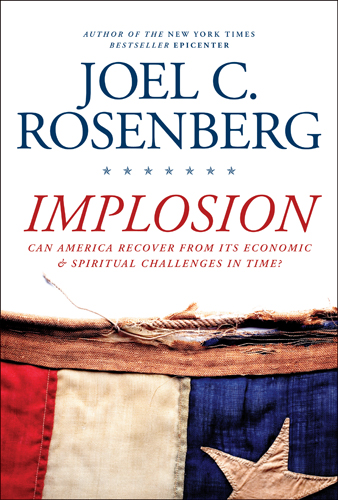
Book Review: Implosion

Recently, I listened as a couple friends tried to pick the one thing which they could present as uniquely American. Perhaps they had experienced some disillusionment, because the only thing they could name was the hamburger…

I don’t agree with them—there are any number of things that we could associate with the American identity, from apple pies to reality TV—but their question returned to me with new significance as I was reading Joel Rosenberg’s Implosion, a nonfiction look at the United States’s current state of health. What does the US have to offer the world? Or, rather, what is left of our greatness that we can protect, revive, and restore to a world in chaos and fear?

Rosenberg, an author, political expert and homeschooling dad, writes that he has built his career in the two things other people don’t talk about—religion and politics. He deals with both in Implosion, taking a broad look at America’s political, economic, and religious health. While I have not read much of Rosenberg’s fiction, I am familiar with it, and he deals with many of the same themes in this book.


In Implosion, Rosenberg doesn’t offer immediate reforms, or sure-fire cures, but he does highlight major problems in American society, and the disturbing reality of where we're at.

In the first couple of chapters, Rosenberg gives a sweeping overview of the doomsday predictions from political leaders and pollsters. I found these chapters difficult to read, but once past them, Rosenberg addresses a wide array of issues, from the role of Scripture in looking at current events to the accuracy of prophetic revelation to major dangers the US faces today. He looks at the possibility of a crippling terrorist attack, an economic meltdown, a devastating earthquake, and even the likely impact that the Rapture could have on today’s society and economy.

I disagreed with Rosenberg on a couple issues, the first being that America is in a uniquely catastrophic state. We are in bad condition, yes—but much of his evidence relies on pundits’ hyperbole. He speaks of recent natural disasters as the ‘worst’ earthquake ever, the ‘most dangerous’ point in our history. I can’t cite chapter and verse like Rosenberg, but I know that many other eras saw their own time as “End Times.” From the American Revolution, the Civil War, WWII, and every era in between, people have proclaimed that theirs is the highest, or the worst, the most advanced, or the most degenerate of societies. It’s the way we think as humans because we so often lack historical perspective.

In the chapters describing the US’s immanent collapse, therefore, I tended to discount some of Rosenberg’s predictions. This did not affect, however, the urgency of his message that we need to shape up, and we need to shape up now.

Moreover, for me, this urgency raised another question—if this is how things are now, where will we be raising our children? Rosenberg doesn’t address this question in Implosion, apparently because he doesn’t think it will be relevant if we can’t turn our country around at once.

Even when he lays out a devastating case for change, though, Rosenberg doesn’t point to political cures. Instead, he argues for a religious reawakening. The last third of the book reviews America’s original Great Awakenings, analyzing those turning points in our history and describing the influence of several key religious leaders. These include leaders many people know—Charles and John Wesley, Jonathan Edwards, George Whitefield—and ones we aren’t so familiar with like Lyman Beecher, Francis Asbury, Charles Finny, Timothy Dwight (a president at Yale, as well as a major leader in the Second Great Awakening).

My second, relatively minor disagreement with Rosenberg stems from his arguments for a pre-wrath Rapture. I don’t necessarily think Rosenberg is wrong on this point, but I don’t agree with some of his definitions on this position. (Rosenberg thinks the ‘wrath’ which Christians do not need to fear means the Tribulation, while I think it means the final judgment; he takes the churches in the first chapters of Revelation as figurative types, while I think they were actual 1st century churches, though they could serve as types as well.)

Rosenberg does make good points, however, and defines his position well. He particularly hammers the urgency of evangelism—that we don’t know the day or the hour, and so we should take advantage of the time that we have, always working as if it is our last opportunity. He demonstrates his own passion for evangelism both by describing what it means to be a Christian and by outlining key steps for Christians to take for their own growth.

This last point forms a strong theme throughout Implosion. Rosenberg argues repeatedly that we should be passionate about the Gospel. And, he asks—what you are passionate about, what you love, do you spend time on that?

In the end, I found Implosion to be a well-written engaging survey of America’s current state. Rosenberg covers some areas more in depth than he does others, and it is easy to see his passion for finding the right lens for understanding current events. If you don’t read much nonfiction, or if you aren’t interested in the topics Rosenberg addresses, this might not be the book for you—but it might be a good read anyway.

[My thanks to Tyndale Publishing House for sending me a review copy of Implosion, in exchange for my honest opinion of this book.]

Thursday, June 28, 2012

The Second Problem of Writing

A long, long time ago, in a post about my story now far removed by time and distance, I once mentioned the difficulties of creating a convincing sequence of events.

My goal then was to finish that story by the end of last year.

Through great negligence and lack of industry on my part, however, I’m still working on the same story, the first volume of my fantasy series. I’m not much further along than I was in November.

I've done some other writing and made progress in other areas in the meantime, including book reviews for this blog. I'll be posting more reviews in the next couple of weeks—two for newly released novels by Davis Bunn, and another for Implosion by Joel C. Rosenberg. Still, I haven't gotten much done on my own book.


Anna reached the end of her journey to Winallwy, arrived safe at the castle with the secret treasure, and then promptly froze because she didn’t know what to do with it or whom she should give it to. In fact, it seems that the story has gone backwards since then. I’ve had doubts about whether Anna actually reached Winallwy, or whether the secret treasure at the center of her journey is really the “secret treasure”—always hard to decide, considering I don’t claim even now to know what the “secret treasure” is.

Such is the writer’s life, especially when the writer starts into a novel without sufficient planning.

And such being the case, I’ve not posted much about my story in recent months. I’ve given it the silent treatment (metaphorically speaking), beaten my head against the wall a few times, and even tried to start one or two new drafts of the story.

I made a new attempt at that last night and wrote the first 400 words to a new opening scene. We’ll see if it lasts.

All this leads me back to the second major problem implicit in developing a convincing sequence of events (sometimes known as a story). I described the first in a February post about dead verbage. The second, namely, is that in order to write a story, it is necessary to know what the story is about.

Perhaps that should be known as the first major problem of writing?

It’s really easy to have an idea, a dream. It’s not so easy to turn that dream into reality. Sometimes it’s not fun even when the dream turns out to be the reality—Anna is finding that out for herself at the moment.

####

“The road grew clearer as they went along—in a few places, the old paving stones broke above the sandy crust—but twice before nightfall, the ravines cut across their track.

“Both times, when they scrambled down the steep sides, it took them nearly twenty minutes and a half-mile detour before they could clamber out. Then they came up again into the wind and straggled back to the road, picking their way over rutted trails. Once, Mitka started to fall behind, until they stopped and waited while Lug helped her up the last slope. The others were dragging as well, when Liegenor finally paused and told them they could make camp.”

####

I’ve set a new goal now—to finish this story by the end of the summer. I only need to redo the 20+ chapters I’ve written so far and finish up a dozen more.

It'll be easy once I figure out what the story is about.

So now, where were we headed again?

Thursday, June 21, 2012

In Hot Water


Water heaters are a wonderful invention—we have one here at the lodge.

“Okay,” you say. “So do we.”

We also have an emergency water heater system:


Last week, our hot water heater decided to go on strike. Three consecutive days it went on strike. (It seemed to think we were seriously overworking it.)

It was smart, too.

It waited just until everyone had finished breakfast and we were stacking dishes into the sink to wash. Then it quit. The first time, Jael reset it and it gave in.

The second time, about the time we finished dinner, it quit again. Jael reset it—and reset it another time. Finally, it cooperated.

The third time—

“Jael, do you want to go kick the water heater again?”

After a while, we discovered an effective threat, a threat strong enough to keep the water heater running—we filled two very large pots with water and put them on the stove to boil. Meanwhile, we began rinsing dishes in cold water and stacking them in one sink to wash so we could move them to another sink to rinse and sanitize. About the time the water in the pots started to boil, the water heater began working again.

We kept the pots on the stove for about two days…not simmering, just waiting. Threatening, you might say.

Now, we live in a place where water heaters do not grow on trees. If you want a new one, you need to call someone in town to pick it out and get it to the airfield so you can get it shipped out to you. (Freight always gets bumped in favor of passengers.) Fortunately for us, though, someone had a spare water heater sitting around that we could install. It just needed a different size of connectors.

They arrived this week, and we now have a water heater again.

As I said, water heaters are a wonderful invention.

Our new one is a trifle unstable. As one of those newfangled instant heaters, it can deliver hot water without needing to heat a huge tank. It doesn’t always deliver the water at a consistent heat. It also looks rather like an alien invention (more on those soon), but at least we have hot water again when we need it.

Now if the electricity only keeps running…

Friday, June 8, 2012

Night Shot 14: Home

While some may believe that real stories never end, the time has come now for this story to end. The story started back in March as a random post about cameras. It continued through the surprise visit of Captain Nwin and Jerry's subsequent efforts to catch the mysterious Shadow. I hope you have enjoyed the chase! If you choose to wonder how it might continue, so be it. But now, for this blog, and for Jerry, this is the final episode of Night Shot, in which…

#####

In the east, a gold haze spread across the sky. The light gleamed along thin, bright wisps of cloud and shimmered on the dark silhouettes of the pines. Jerry sat and watched it for a long time—longer than he quite remembered.

At last, though, he shook himself and looked around.

Captain Nwin sat next to him, leaning against one of the platform posts of the old train station, watching the dawn. Silas slumped next to her, his head nodding forward.

Carefully, Jerry raised his camera and slid back until he could get a clear shot of Captain Nwin looking away from him, facing the sunrise. He held his breath as the camera clicked, and then sat back to look at the photo on the display panel.


The captain turned around. She raised an eyebrow when she saw him with the camera, but she only smiled. “Would you believe it?” she said. “I’ve never seen a meteor shower before. I’m glad Silas told us about this one.”

“No?” Jerry grinned sheepishly. Setting the camera down, he slid forward and sat beside her on the edge of the platform, his back resting against the wall. “I haven’t either, at least not since I was a kid.”

“Will you have a busy day today?”

Jerry considered. “Not really. Normal projects, that’s all. What about you?”

“It’ll be kind of busy,” Captain Nwin admitted. “I’ve been on assignment with the local force here, but that ended yesterday—a big raid on a smuggling ring. Or it was supposed to be, but things got a little mixed up.”

“Drugs?”

She shook her head. “Old furniture, actually. That's part of the mix-up. We’ll have lots of paperwork today to sort it out, and then I’ll have to fly out this afternoon. Minnesota—to follow some connections up there.”

“Oh.” Jerry didn't know what to say. “Isn’t it still snowing up there, or something?”

The captain laughed. “Not when I checked last. I grew up there, and we did get summer, you know.” She studied him. “So what do you do? Where you do you work?”

“I work long-distance for a tech company. Mostly writing patches for software, but sometimes I get to test security for their clients.” Jerry hesitated, before he added, “I’ve been trying to start my own photography business.”

“How’s it working?”

“Not very well,” Jerry admitted. “Though someone actually bought a couple prints yesterday, and asked about a photo shoot. First time, so—” he hesitated. “I wondered if you wouldn’t like to—if you would want to go out sometime. Celebrate, I guess?”

“I don’t know—” Captain Nwin seemed about to shake her head. Then she smiled. “Maybe when I get back?”

Jerry nodded. They were looking at each other, but Jerry glanced away quickly and stared out at the sunlight as it spreading across the dark trees. His fingers itched to hold his camera, to capture the pink flush of the clouds and the pale purple-blue above them. He leaned back, though, and left the camera where it was.

...

Beside them, Silas stirred and sat up with a grunt. “What time is it?” he asked.

Jerry pulled out his phone and checked. “Six-forty,” he said.

Captain Nwin scrambled to her feet. Jerry got up also and stretched, but the captain was already heading toward the road. “Phone call at seven,” she explained over her shoulder. “And at seven-thirty, and at eight. I’m going to need so much coffee this morning. Sorry! I’ll call you guys when I get home next week.”

Jerry helped pull Silas to his feet. As Silas shook himself, stretching stiffly, Jerry grabbed his camera bag and camera.

They were nearly to the road, about twenty feet behind the captain when Silas stopped abruptly and gave a curious, shrill whistle. Jerry looked around, surprised, but Silas was chuckling. “There she is—silly kitty,” he told Jerry. “I told you we would find her around here.”

Jerry looked and saw Silas’s gray cat sitting bolt upright, as cats would, in the grass by the ditch. Silas clucked to the cat, and she uncurled herself and came forward, picking her way over the damp grass.

Silas bent and picked her up, rubbing her chin. “Good kitty,” he crooned. “Let’s go find something to eat, shall we?”

Captain Nwin had heard Silas’s whistle and turned back briefly. When she saw the cat, she laughed and waved to them, before hurrying on.


About twenty minutes later, Jerry pulled up in front of his house just as his neighbor came down the front walk. They passed each other and nodded briefly. Jerry caught his neighbor’s curious glance, but neither of them spoke. Then the neighbor got in his own car and started the engine, while Jerry strolled up the walk and let himself into his side of the duplex.

As he closed the door behind himself and set his camera bag down on the counter, he realized suddenly that he wasn’t particularly tired—not yet, anyway.

He went into the kitchen and poked about for a minute before he washed off a plate and a coffee mug from the stack in the sink. He got the pancake mix down from its box on the top shelf above the stove, but he had to hunt about a few minutes longer before he found a skillet and set it on the stovetop to heat. Slowly, carefully, Jerry made himself breakfast, ate it, washed his dishes, and even wiped down the counters. Finally, he finished and pulled out his laptop to boot it.

As he sat down to work, though, he couldn’t shake the odd feeling that he was forgetting something.