Pages

Tuesday, August 7, 2012

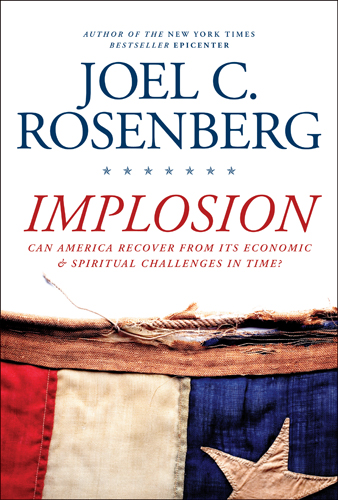
Book Review: Implosion

Recently, I listened as a couple friends tried to pick the one thing which they could present as uniquely American. Perhaps they had experienced some disillusionment, because the only thing they could name was the hamburger…

I don’t agree with them—there are any number of things that we could associate with the American identity, from apple pies to reality TV—but their question returned to me with new significance as I was reading Joel Rosenberg’s Implosion, a nonfiction look at the United States’s current state of health. What does the US have to offer the world? Or, rather, what is left of our greatness that we can protect, revive, and restore to a world in chaos and fear?

Rosenberg, an author, political expert and homeschooling dad, writes that he has built his career in the two things other people don’t talk about—religion and politics. He deals with both in Implosion, taking a broad look at America’s political, economic, and religious health. While I have not read much of Rosenberg’s fiction, I am familiar with it, and he deals with many of the same themes in this book.


In Implosion, Rosenberg doesn’t offer immediate reforms, or sure-fire cures, but he does highlight major problems in American society, and the disturbing reality of where we're at.

In the first couple of chapters, Rosenberg gives a sweeping overview of the doomsday predictions from political leaders and pollsters. I found these chapters difficult to read, but once past them, Rosenberg addresses a wide array of issues, from the role of Scripture in looking at current events to the accuracy of prophetic revelation to major dangers the US faces today. He looks at the possibility of a crippling terrorist attack, an economic meltdown, a devastating earthquake, and even the likely impact that the Rapture could have on today’s society and economy.

I disagreed with Rosenberg on a couple issues, the first being that America is in a uniquely catastrophic state. We are in bad condition, yes—but much of his evidence relies on pundits’ hyperbole. He speaks of recent natural disasters as the ‘worst’ earthquake ever, the ‘most dangerous’ point in our history. I can’t cite chapter and verse like Rosenberg, but I know that many other eras saw their own time as “End Times.” From the American Revolution, the Civil War, WWII, and every era in between, people have proclaimed that theirs is the highest, or the worst, the most advanced, or the most degenerate of societies. It’s the way we think as humans because we so often lack historical perspective.

In the chapters describing the US’s immanent collapse, therefore, I tended to discount some of Rosenberg’s predictions. This did not affect, however, the urgency of his message that we need to shape up, and we need to shape up now.

Moreover, for me, this urgency raised another question—if this is how things are now, where will we be raising our children? Rosenberg doesn’t address this question in Implosion, apparently because he doesn’t think it will be relevant if we can’t turn our country around at once.

Even when he lays out a devastating case for change, though, Rosenberg doesn’t point to political cures. Instead, he argues for a religious reawakening. The last third of the book reviews America’s original Great Awakenings, analyzing those turning points in our history and describing the influence of several key religious leaders. These include leaders many people know—Charles and John Wesley, Jonathan Edwards, George Whitefield—and ones we aren’t so familiar with like Lyman Beecher, Francis Asbury, Charles Finny, Timothy Dwight (a president at Yale, as well as a major leader in the Second Great Awakening).

My second, relatively minor disagreement with Rosenberg stems from his arguments for a pre-wrath Rapture. I don’t necessarily think Rosenberg is wrong on this point, but I don’t agree with some of his definitions on this position. (Rosenberg thinks the ‘wrath’ which Christians do not need to fear means the Tribulation, while I think it means the final judgment; he takes the churches in the first chapters of Revelation as figurative types, while I think they were actual 1st century churches, though they could serve as types as well.)

Rosenberg does make good points, however, and defines his position well. He particularly hammers the urgency of evangelism—that we don’t know the day or the hour, and so we should take advantage of the time that we have, always working as if it is our last opportunity. He demonstrates his own passion for evangelism both by describing what it means to be a Christian and by outlining key steps for Christians to take for their own growth.

This last point forms a strong theme throughout Implosion. Rosenberg argues repeatedly that we should be passionate about the Gospel. And, he asks—what you are passionate about, what you love, do you spend time on that?

In the end, I found Implosion to be a well-written engaging survey of America’s current state. Rosenberg covers some areas more in depth than he does others, and it is easy to see his passion for finding the right lens for understanding current events. If you don’t read much nonfiction, or if you aren’t interested in the topics Rosenberg addresses, this might not be the book for you—but it might be a good read anyway.

[My thanks to Tyndale Publishing House for sending me a review copy of Implosion, in exchange for my honest opinion of this book.]

Friday, July 27, 2012

Location, location...

Until this week, I never realized how lucky I was to land in Port Alsworth last year.

When I came up the first time, I had talked to a couple people who worked here before, but talking to people doesn’t accurately convey a landscape or a reality. I had no idea where I would be staying for the next two months. Somehow I pictured flat, open grass areas—I still have no idea why...

Instead, after a one-hour flight to Seattle, and a three-hour flight from Seattle to Anchorage, and another hour-long flight from there to Port Alsworth, I landed here—on a low knoll overlooking a small bay with a range of mountains just outside my window.


 It was amazing.

The work wasn’t always as amazing as the scenery, but I enjoyed it, and I got out occasionally to explore this area.

All that still applied when I came back this summer.

Then, on Monday this week, we had a day when there were no guests staying at the lodge. It gave us a nice break after nearly a month of non-stop rush. To celebrate (or else just to take advantage of the short break), Glen and Leyla took their family, the family dog, a pilot who flies for the lodge, and the lodge crew out on a boating trip.


I haven’t been fishing in ten years, but I picked up a one-day license before we left.

We boated up the lake to the mouth of a creek and set up camp along the beach. Jael and Leyla had packed hotdogs and s’mores. The farm guys (with help from everyone else) started a bonfire with the drift wood and old spruce boughs.

And Jael headed out into the water with her rubber hip-boots and her fly-rod. A couple other people followed her out, wading along a narrow shelf along the mouth of the creek.

After some hesitation, and some help with a reel-rod, I followed them into the water.

I kept my distance, though. In my experience with fishing, distance can be a key factor. Unfortunately, all the fish were biting around the creek. When I didn’t catch anything in the first ten minutes or so, Glen suggested I move closer to the creek, closer to Jael.

Right next to her—

At home, I would never have dared fish just ten feet away from someone else, but here it seemed okay. It helped that she’s right-handed and I’m left, so we could fish on opposite sides from each other. And it seemed to work too—I caught two graylings before deciding it was time to try the hotdogs instead. (It’s catch-and-release fishing up here.)


That was on Monday.

On Tuesday, we also had no guests, and we had nearly all the lodge work done before lunch. After lunch, Jael went out flying and she asked me to tag along with her on a cross-country flight. (No, not ‘across the country,' just across the countryside to another small village.)

It takes a lot of work to get a small plane ready for takeoff—check both fuel tanks, check the oil, check all the flaps and struts and wires, bang on some other things, and so on. Some of it might look amusing to the uninitiated. I stood by and stayed out of the way while Jael did the work, but eventually we loaded up and taxied onto the runway.


About an hour later, we landed in Igiugig. Think of a small huddle of houses along a river, at the lower end of the largest freshwater lake in Alaska.


At Igiugig, everything is different.

Yes, I realize it’s not fair to make a judgment after five minutes in a village. Still, it seems safe to say that if I’d been working there instead of here last summer—well, I probably wouldn’t be working there again this summer.

There are mountains in the distance, I will admit. You just can’t see them because everything close up is flat, with a smudge of bushes…


…And a thick haze of mosquitos.


Mosquitos and mountains, sure. Just mosquitos, no thanks.

I’m glad to be here, not there.

Thursday, July 19, 2012

One Year Out

Today marks exactly one year from my first post on this blog.

So many things have happened that I didn’t expect—to be back in Alaska for another summer, to become a blog reviewer for Tyndale, to still be working on the first book of my Areaex series (though I should hardly be surprised by that), to be still posting steadily after a full year, among other things.


This week also marks my second month working at the Farm Lodge this summer. (For those of you who like numbers, I’ve now been here as long this summer as I was here last summer. I’m also planning to stay here for another three months, until the fall. I haven’t set a return date yet, but it will probably be about mid-October.)


How have things gone here recently?

Work is good, work is busy, work is crazy—work is good?

And when we have fourteen guests show up unexpectedly one evening, I do want to ask whether they are heading to Rivendell or running from the orcs. It might make a difference for tonight? (The official story was that they had been delayed by bad weather on their way to another lodge.)


Some days we have lots of sunshine, some days we have fog and mist so thick that only the large planes can make it out to Anchorage. After a couple weeks of that, it was nice to see the sun again recently.

Along the way, life is full of surprises (yes, that is a cliche), and unexpected things are happening every day. It's almost like finding dogwood that grows on the ground instead of in trees. Fields of white dogwood—how does that sound?


So life is crazy; life is good.

Friends are good also—I've enjoyed hearing from a number of people while I've been here, and I apologize to those I haven't kept up with.

And finally, the mountains are still amazing, even at midnight.


Yes, I took that photo very close to midnight a couple weeks ago. I've only stayed up that late a couple times, but it can be hard sometimes to remember that I still need sleep.

Who needs sleep when you can still get great photos outside?

Tuesday, July 17, 2012

PTA's Believe It Or Not 2.0

I need someone to explain...


We have a washing machine that chews up rubber gloves for breakfast and spits them out again as left-handed gloves.

Seriously, we still have two full pairs of medium gloves, plus one random large right handed glove, in our cleaning box. And then these.

I actually found another one after taking the photo. Okay, I am left-handed, but still...

Wednesday, July 11, 2012

Hidden in Dreams: Book Review

After a couple late nights recently, I’m excited to post this review for the second of Davis Bunn’s newly released novels, Hidden in Dreams.

My conclusion?

It’s a bizarre world that Professor Elena Burroughs enters.

It’s a world which can twist a person’s mind with fears and confusion—and above all, with dreams.

Elena has landed at a private university in her own field of psychology. It is her refuge after her world shatters under the stress of a controversial book with an even more controversial claim—that God can use dream to warn people about the future.

Then Elena has her own dream that demands her attention and the attention of the entire world.


Think banks and stock markets are boring, not to mention confusing? Throughout Hidden in Dreams, Davis Bunn ties the diverse threads of economics, financial panics, and psychology into an amazing brain thriller. After she and fourteen other Dreamers receive identical dreams—warnings, they believe—Elena Burroughs finds herself back on the national stage, the last place she ever wanted to be, and she’s trying to stop the ultimate disaster.

It’s not nuclear fallout, but a financial meltdown that’s coming.

Along the way, Elena experiences a personal waking, as she recovers from her husband’s death years before, and discovers a new life and hints of a new love. Hidden in Dreams continues Elena’s story from the first book in this series—The Book of Dreams. Hidden in Dreams hints at these previous events in Elena’s life, but I had no difficulty in following the plot without having read the earlier book.

I would rate this book a full five stars—the story and characters captured my imagination. Yesterday, I posted my review of Bunn’s other new release, Rare Earth—originally, based on the descriptions of the two books, I expected to prefer Rare Earth as an action-based story. Both books actually have a similar balance of action, investigation and introspection. Both also focus on the protagonist’s internal and external quests for healing, but Hidden in Dreams takes the prize for its depth and brilliance. I was intrigued by my first quick breeze through the book, and found it even more enjoyable with my second, deeper read.

By the end of the story, the question isn’t whether God can work through dreams, but whether man can recognize his need and rely on God.

I would recommend this book to any of Bunn’s fans, or anyone else in search of a strong, fast read.

You can read find out more about the book at Davis Bunn's site, www.davisbunn.com, or read the first chapter of Hidden in Dreams here.

[My thanks to Howard Books, a division of Simon & Schusters for the complimentary copy of this book that I received. I was not required to write a positive review, and the opinions I have expressed are my own. I am disclosing this in accordance with the Federal Trade Commission's 16 CFR, Part 25.]

#####

Bonus: Q & A from Davis Bunn


Q: How much research did you have to conduct to write this intriguing story?

A: In a way, I suppose you could say I’ve been researching this story all my adult life. I did my studies in international economics and finance. Observing the difficulties our nation and economy has faced over the past three years, as well as what we personally have endured, has been tough. It really was great to have this chance to give voice to what we increasingly hear, that the people at fault need to be brought to justice, and the risk of another economic collapse needs to be halted.
Q: In writing a sequel it’s always a challenge to include enough back story to satisfy those who haven’t read the first book while still making sure the book stands alone. How do you approach this dilemma?

A: You’re right, it can indeed be troublesome, but this time it all fell together very easily. The structure just flowed. That sometimes happens, where the story seems to create itself. I wish it was true all the time. I can’t even say why it was such a smooth process with Hidden in Dreams. But there was a sense of impatience about the back story, as though I needed to fit in just a few paragraphs, but I couldn’t allow myself or the reader to be drawn too far from this new story’s flow.
Q: Why do you write fiction?

A: I became a believer at age 28. Up to that time, ever since graduating, I had been working in international business. I came to faith while working as a consultant in Germany. I started writing two weeks later. Up to that point, I had never picked up a pen in my life to write anything longer than a business report. But I had always been an avid reader. And the moment I started, that very first instant, I had the sense of invitation. It was the first time I had ever experienced that incredible sense of being drawn in a new, divinely inspired direction.
I wrote for nine years and finished seven novels before my first was accepted for publication. Simply because I had received a sense of calling did not mean I was ready to serve. First the diamond had to be polished. Hard and painful as that was.

Tuesday, July 10, 2012

Rare Earth: Book Review

(This will be the first of two book reviews this week, since I am privileged to review both of Davis Bunn’s newly released novels, Rare Earth and Hidden in Dreams. Check back Wednesday for my review of Hidden in Dreams!)

#####

Africa is alive…barely.

Marc Royce, former Baltimore accountant, arrives in Kenya with a new job title—American relief worker, carrying supplies to a refugee camp near Kitale. His first view of his new job? An image of death.

A drought devastates the land, a volcanic eruption coats villages with ash like snow, and vultures move in for the spoils. Under the ash and the fear, however, Marc finds that the people of Africa—and the land itself—are still vibrant with life. Then Marc realizes that some of the disasters are man-made, and not all of the displaced refugees should be refugees.

And so Marc finds he has yet another job, with love and death waiting in the wings as he searches through the African dust for answers to his questions.


I would rate Davis Bunn’s action novel Rare Earth four stars out of five for an intriguing story, amazing setting, but some choppy opening scenes. The book continues Marc Royce’s story from the 2011 novel Lion of Babylon, moving his work from war-torn Iraq to disaster-plagued Africa. I haven’t read the first book in the series, but Rare Earth is written as a stand-alone story, and I had no problem picking up the story. I did struggle initially to figure out what Marc’s real mission in Africa meant, beyond the big clue in the title. By the book’s mid-point, however, I was ready to stay up late to finish the story.

Marc’s challenges include the land itself, as well as many of the people he meets along the way, from the UN workers and private contractors who bet on his chances of survival, to the African pastor Charles and the Israeli nurse Kitra who should be helping him in his search, but raise questions of their own. The characters themselves develop a little through the course of the story, and I wasn’t much surprised by the book’s ending, but I enjoyed the journey all the same—Africa feels real in this book, and it is an amazing, vibrant encounter.

I would recommend this book for teens and adults, and especially anyone who likes faith-based action stories.

For more information, you can check out Davis Bunn's website at www.davisbunn.com, or read the first three chapters of Rare Earth here.

[My thanks to Bethany House Publishers for the complimentary copy of this book I received. I was not required to write a positive review, and the opinions I have expressed are my own. I am disclosing this in accordance with the Federal Trade Commission's 16 CFR, Part 255.]

#####

Bonus Q & A from Davis Bunn:

What type of research did you do for this series?
I worked in Africa for four years early in my adult life. I was not a believer at that time. I came to faith four years later. I taught in Kenya last year, the first time I had been back to sub-Sahara Africa in almost twenty years. Going back to Africa now, as a believer, has opened my eyes to many things. Seeing with the compassion of sharing faith and seeking to serve means that I do not merely observe, I share with them. I hope this comes across in my story.
Research is a huge component of all of my stories. But with Lion of Babylon and Rare Earth, the situation was quite different. In both these Royce novels, I was combining knowledge gained in my previous business life with the perspective gained from my walk in faith. It has been quite a fulfilling experience, personally, to revisit these lands and see them through the eyes of our compassionate God.


What was your favorite scene to write in Rare Earth?
It is very rare that a first scene holds such a powerful connection for me. Generally it is one where there is a revelation between characters, or a defining moment when a person’s eyes are truly opened to the eternal for the first time.
But in Rare Earth, when I shut my eyes and envision the story, it is that first scene that blazes into light. Travelling on the UN chopper from Nairobi, watching the volcano take shape upon the horizon. Marc Royce has been sent out there to fail. And to die. I really am pleased with that opening sequence.

Wednesday, July 4, 2012

Today is the 4th of July


Today is the day for picnics, and parties, and fireworks.

So let’s celebrate!

Picnics, check.

Parties, check.

Fireworks?

No, there are no fireworks.

This is Alaska, and it is summer time. It doesn’t get dark around here.

Actually, it gets almost dark around 2:30 am, but only when it’s cloudy. Even then, even at that hour of the morning, it doesn’t get all dark. Just darkish.

Thus, around here the big fireworks are saved for New Year’s. Apparently, it’s dark enough to see them then.


With the 4th here, however, it finally feels like summer has come, and the clouds with it. The past few days have been cold and cloudy, with light drizzle at times. (It’s starting to feel almost like Oregon.) The guests have been arriving as well, so we started this morning with a mad rush to get cabins cleaned and ready for new arrivals. Then it was time for a picnic on the lawn and a quiet, relaxing afternoon.

How do you describe a Port Alsworth 4th of July picnic?

How do you describe having an entire town on your lawn?

Let's just say it's kind of fun. It makes a really long line at the food table, and it means quite a number of people around the picnic tables, yard chairs, benches, cabin porches, cabin boardwalks, and everywhere else available. But it's fun.
More importantly, though—how do you describe singing patriotic hymns in church?

The first time this happened, around Memorial Day weekend, I experienced a small amount of shock—singing Battle Hymn of the Republic in church, sure! But America the Beautiful?

Then I realized that while we may be singing of our country, we're singing as a prayer to God on behalf of our nation:

####

My country,' tis of thee,
sweet land of liberty, of thee I sing;
land where my fathers died,
land of the pilgrims' pride,
from every mountainside let freedom ring!

My native country, thee,
land of the noble free, thy name I love;
I love thy rocks and rills,
thy woods and templed hills;
my heart with rapture thrills, like that above.

Let music swell the breeze,
and ring from all the trees sweet freedom's song;
let mortal tongues awake;
let all that breathe partake;
let rocks their silence break, the sound prolong.

Our fathers' God, to thee,
author of liberty, to thee we sing;
long may our land be bright
with freedom's holy light;
protect us by thy might, great God, our King.

#####

Isn't that the only thing we can say?


Happy 4th of July!

Thursday, June 28, 2012

The Second Problem of Writing

A long, long time ago, in a post about my story now far removed by time and distance, I once mentioned the difficulties of creating a convincing sequence of events.

My goal then was to finish that story by the end of last year.

Through great negligence and lack of industry on my part, however, I’m still working on the same story, the first volume of my fantasy series. I’m not much further along than I was in November.

I've done some other writing and made progress in other areas in the meantime, including book reviews for this blog. I'll be posting more reviews in the next couple of weeks—two for newly released novels by Davis Bunn, and another for Implosion by Joel C. Rosenberg. Still, I haven't gotten much done on my own book.


Anna reached the end of her journey to Winallwy, arrived safe at the castle with the secret treasure, and then promptly froze because she didn’t know what to do with it or whom she should give it to. In fact, it seems that the story has gone backwards since then. I’ve had doubts about whether Anna actually reached Winallwy, or whether the secret treasure at the center of her journey is really the “secret treasure”—always hard to decide, considering I don’t claim even now to know what the “secret treasure” is.

Such is the writer’s life, especially when the writer starts into a novel without sufficient planning.

And such being the case, I’ve not posted much about my story in recent months. I’ve given it the silent treatment (metaphorically speaking), beaten my head against the wall a few times, and even tried to start one or two new drafts of the story.

I made a new attempt at that last night and wrote the first 400 words to a new opening scene. We’ll see if it lasts.

All this leads me back to the second major problem implicit in developing a convincing sequence of events (sometimes known as a story). I described the first in a February post about dead verbage. The second, namely, is that in order to write a story, it is necessary to know what the story is about.

Perhaps that should be known as the first major problem of writing?

It’s really easy to have an idea, a dream. It’s not so easy to turn that dream into reality. Sometimes it’s not fun even when the dream turns out to be the reality—Anna is finding that out for herself at the moment.

####

“The road grew clearer as they went along—in a few places, the old paving stones broke above the sandy crust—but twice before nightfall, the ravines cut across their track.

“Both times, when they scrambled down the steep sides, it took them nearly twenty minutes and a half-mile detour before they could clamber out. Then they came up again into the wind and straggled back to the road, picking their way over rutted trails. Once, Mitka started to fall behind, until they stopped and waited while Lug helped her up the last slope. The others were dragging as well, when Liegenor finally paused and told them they could make camp.”

####

I’ve set a new goal now—to finish this story by the end of the summer. I only need to redo the 20+ chapters I’ve written so far and finish up a dozen more.

It'll be easy once I figure out what the story is about.

So now, where were we headed again?

Saturday, June 23, 2012

Out of Town


This afternoon, in a mad dash from the lodge to the hanger, I managed to catch a ride on the afternoon sight-seeing tour:


Jael, our cook, flew the kitchen, and she took me along in her Pacer for an out-of-town whirl. We didn't go too far, just up river to see the smaller lake south of Tanalian, on around the mountain and down Lake Clark a short distance.


Flying can give things a new perspective.


Still, we made it home again in time for an afternoon slice of cantaloupe. (That's another big treat around here.) Then it was back to work at the lodge. One month down, and a summer to go!

Thursday, June 21, 2012

In Hot Water


Water heaters are a wonderful invention—we have one here at the lodge.

“Okay,” you say. “So do we.”

We also have an emergency water heater system:


Last week, our hot water heater decided to go on strike. Three consecutive days it went on strike. (It seemed to think we were seriously overworking it.)

It was smart, too.

It waited just until everyone had finished breakfast and we were stacking dishes into the sink to wash. Then it quit. The first time, Jael reset it and it gave in.

The second time, about the time we finished dinner, it quit again. Jael reset it—and reset it another time. Finally, it cooperated.

The third time—

“Jael, do you want to go kick the water heater again?”

After a while, we discovered an effective threat, a threat strong enough to keep the water heater running—we filled two very large pots with water and put them on the stove to boil. Meanwhile, we began rinsing dishes in cold water and stacking them in one sink to wash so we could move them to another sink to rinse and sanitize. About the time the water in the pots started to boil, the water heater began working again.

We kept the pots on the stove for about two days…not simmering, just waiting. Threatening, you might say.

Now, we live in a place where water heaters do not grow on trees. If you want a new one, you need to call someone in town to pick it out and get it to the airfield so you can get it shipped out to you. (Freight always gets bumped in favor of passengers.) Fortunately for us, though, someone had a spare water heater sitting around that we could install. It just needed a different size of connectors.

They arrived this week, and we now have a water heater again.

As I said, water heaters are a wonderful invention.

Our new one is a trifle unstable. As one of those newfangled instant heaters, it can deliver hot water without needing to heat a huge tank. It doesn’t always deliver the water at a consistent heat. It also looks rather like an alien invention (more on those soon), but at least we have hot water again when we need it.

Now if the electricity only keeps running…